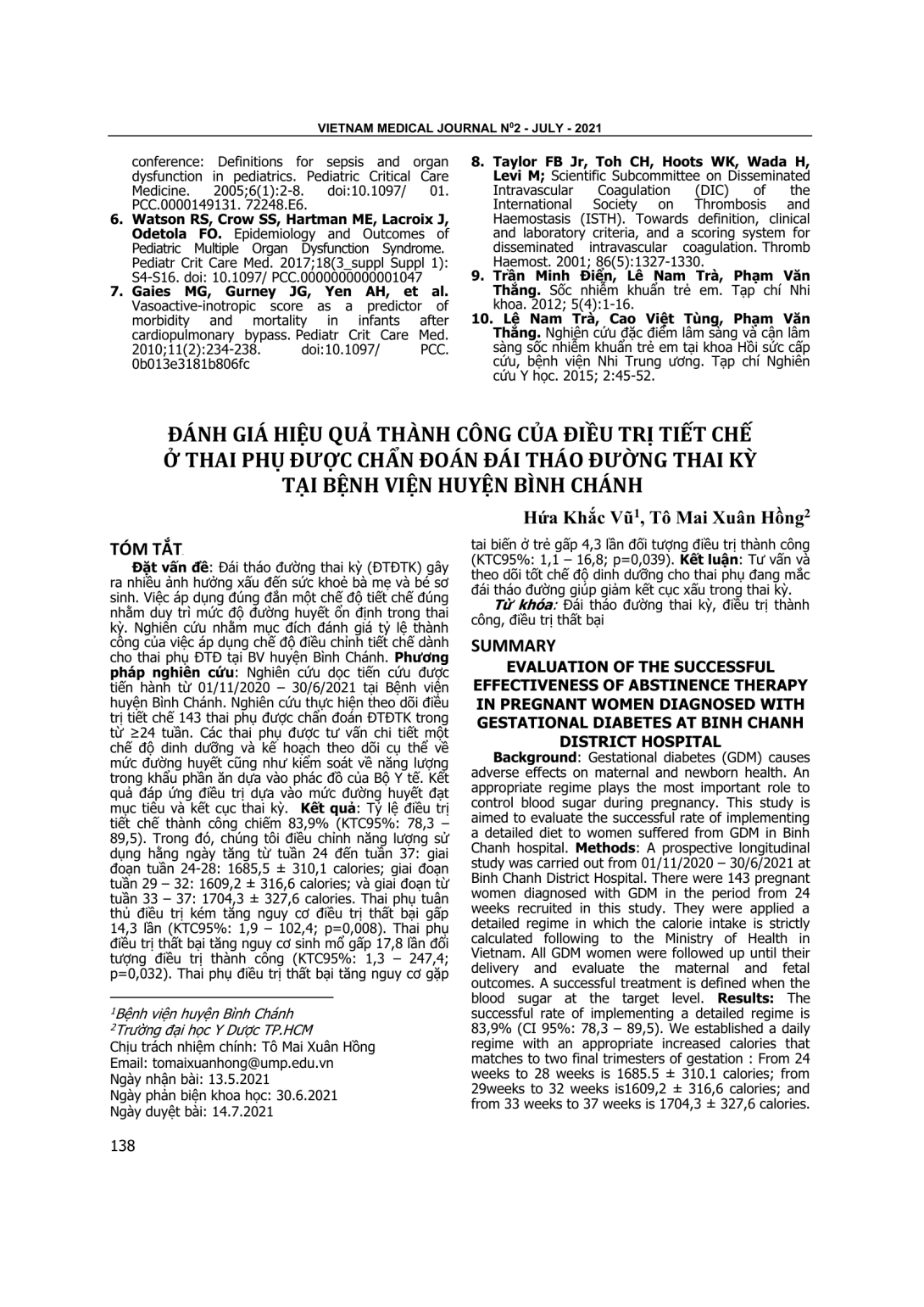
: Đái tháo đường thai kỳ (ĐTĐTK) gây ra nhiều ảnh hưởng xấu đến sức khoẻ bà mẹ và bé sơ sinh. Việc áp dụng đúng đắn một chế độ tiết chế đúng nhằm duy trì mức độ đường huyết ổn định trong thai kỳ. Nghiên cứu nhằm mục đích đánh giá tỷ lệ thành công của việc áp dụng chế độ điều chỉnh tiết chế dành cho thai phụ ĐTĐ tại BV huyện Bình Chánh. Phương pháp nghiên cứu: Nghiên cứu dọc tiến cứu được tiến hành từ 01/11/2020 – 30/6/2021 tại Bệnh viện huyện Bình Chánh. Nghiên cứu thực hiện theo dõi điều trị tiết chế 143 thai phụ được chẩn đoán ĐTĐTK trong từ ≥24 tuần. Các thai phụ được tư vấn chi tiết một chế độ dinh dưỡng và kế hoạch theo dõi cụ thể về mức đường huyết cũng như kiểm soát về năng lượng trong khẩu phần ăn dựa vào phác đồ của Bộ Y tế. Kết quả đáp ứng điều trị dựa vào mức đường huyết đạt mục tiêu và kết cục thai kỳ. Kết quả: Tỷ lệ điều trị tiết chế thành công chiếm 83,9% (KTC95%: 78,3 – 89,5). Trong đó, chúng tôi điều chỉnh năng lượng sử dụng hằng ngày tăng từ tuần 24 đến tuần 37: giai đoạn tuần 24-28: 1685,5 ± 310,1 calories; giai đoạn tuần 29 – 32: 1609,2 ± 316,6 calories; và giai đoạn từ tuần 33 – 37: 1704,3 ± 327,6 calories. Thai phụ tuân thủ điều trị kém tăng nguy cơ điều trị thất bại gấp 14,3 lần (KTC95%: 1,9 – 102,4; p=0,008). Thai phụ điều trị thất bại tăng nguy cơ sinh mổ gấp 17,8 lần đối tượng điều trị thành công (KTC95%: 1,3 – 247,4; p=0,032). Thai phụ điều trị thất bại tăng nguy cơ gặp tai biến ở trẻ gấp 4,3 lần đối tượng điều trị thành công (KTC95%: 1,1 – 16,8; p=0,039). Kết luận: Tư vấn và theo dõi tốt chế độ dinh dưỡng cho thai phụ đang mắc đái tháo đường giúp giảm kết cục xấu trong thai kỳ.
Gestational diabetes (GDM) causes adverse effects on maternal and newborn health. An appropriate regime plays the most important role to control blood sugar during pregnancy. This study is aimed to evaluate the successful rate of implementing a detailed diet to women suffered from GDM in Binh Chanh hospital. Methods: A prospective longitudinal study was carried out from 01/11/2020 – 30/6/2021 at Binh Chanh District Hospital. There were 143 pregnant women diagnosed with GDM in the period from 24 weeks recruited in this study. They were applied a detailed regime in which the calorie intake is strictly calculated following to the Ministry of Health in Vietnam. All GDM women were followed up until their delivery and evaluate the maternal and fetal outcomes. A successful treatment is defined when the blood sugar at the target level. Results: The successful rate of implementing a detailed regime is 83,9% (CI 95%: 78,3 – 89,5). We established a daily regime with an appropriate increased calories that matches to two final trimesters of gestation : From 24 weeks to 28 weeks is 1685.5 ± 310.1 calories; from 29weeks to 32 weeks is1609,2 ± 316,6 calories; and from 33 weeks to 37 weeks is 1704,3 ± 327,6 calories. A treatment failure with blood sugar unmet the target is related to pregnant women who were not strictly followed the regime with a relative risk at 14,3 times (95% CI: 1,9 – 102,4; p=0,008). GDM women with treatment failure are significantly increased risks of caesarean section and neonatal complications from17,8 times higher (95% CI: 1,3 – 247,4; p=0,032) to 4,3 times higher (95% CI: 1,1 – 16,8; p=0,039), respectively. Conclusion: A detailed regime helps GDM women meet the target of blood sugar and reduce the maternal and fetal outcomes.
- Đăng nhập để gửi ý kiến