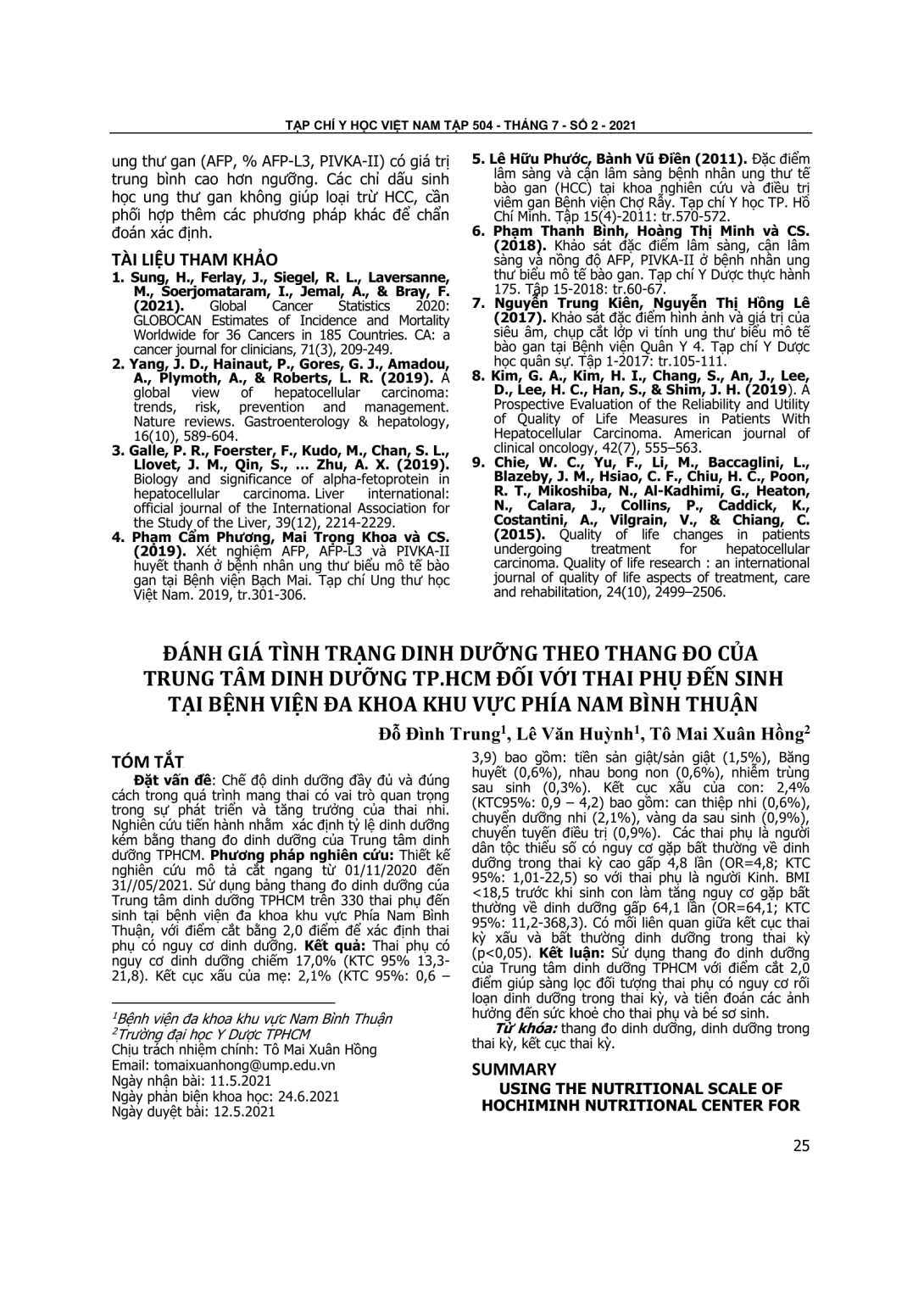
Chế độ dinh dưỡng đầy đủ và đúng cách trong quá trình mang thai có vai trò quan trọng trong sự phát triển và tăng trưởng của thai nhi. Nghiên cứu tiến hành nhằm xác định tỷ lệ dinh dưỡng kém bằng thang đo dinh dưỡng của Trung tâm dinh dưỡng TPHCM. Phương pháp nghiên cứu: Thiết kế nghiên cứu mô tả cắt ngang từ 01/11/2020 đến 31//05/2021. Sử dụng bảng thang đo dinh dưỡng cúa Trung tâm dinh dưỡng TPHCM trên 330 thai phụ đến sinh tại bệnh viện đa khoa khu vực Phía Nam Bình Thuận, với điểm cắt bằng 2,0 điểm để xác định thai phụ có nguy cơ dinh dưỡng. Kết quả: Thai phụ có nguy cơ dinh dưỡng chiếm 17,0% (KTC 95% 13,3- 21,8). Kết cục xấu của mẹ: 2,1% (KTC 95%: 0,6 –3,9) bao gồm: tiền sản giật/sản giật (1,5%), Băng huyết (0,6%), nhau bong non (0,6%), nhiễm trùng sau sinh (0,3%). Kết cục xấu của con: 2,4% (KTC95%: 0,9 – 4,2) bao gồm: can thiệp nhi (0,6%), chuyển dưỡng nhi (2,1%), vàng da sau sinh (0,9%), chuyển tuyến điều trị (0,9%). Các thai phụ là người dân tộc thiểu số có nguy cơ gặp bất thường về dinh dưỡng trong thai kỳ cao gấp 4,8 lần (OR=4,8; KTC 95%: 1,01-22,5) so với thai phụ là người Kinh. BMI <18,5 trước khi sinh con làm tăng nguy cơ gặp bất thường về dinh dưỡng gấp 64,1 lần (OR=64,1; KTC 95%: 11,2-368,3). Có mối liên quan giữa kết cục thai kỳ xấu và bất thường dinh dưỡng trong thai kỳ (p<0,05). Kết luận: Sử dụng thang đo dinh dưỡng của Trung tâm dinh dưỡng TPHCM với điểm cắt 2,0 điểm giúp sàng lọc đối tượng thai phụ có nguy cơ rối loạn dinh dưỡng trong thai kỳ, và tiên đoán các ảnh hưởng đến sức khoẻ cho thai phụ và bé sơ sinh
An appropriate and healthy diet during pregnancy plays an important role to help fetus become growth and wellbeing. The study is aimed to determine the prevalence of poor nutrition by using the nutritional scale of Ho Chi Minh Nutritional Center. Methods: The cross-sectional descriptive study is carried out from November 1st 2020 to May 31st 2021. We applied the nutritional scale of Ho Chi Minh Nutritional Center to assess the nutrition status in 330 pregnant women before giving birth at the general hospital in the South of Binh Thuan. Pregnant women who are considered as risk of nutrition disorders at the cutoff at 2.0 according to Ho Chi Minh Nutritional Center. All pregnant women at risk are closely followed at delivery room and post-partum to evaluate further adverse maternal and neonatal outcomes. Results: The prevalence of pregnant women at risk for nutritional disorders is 17.0% (95% CI 13.3-21.8). Maternal outcomes are 2.1% (95%CI:0.6–3.9) including preeclampsia/eclampsia (1.5%), post-partum haemorrhage (0.6%), placental abruption preterm birth (0.6%), postpartum infection (0.3%). Neonatal outcomes are found in 2.4% (CI 95%: 0.9 – 4.2) including perinatal intervention (0.6%), emergency of pediatric transfer (2.1%), severe neonatal jaundice (0.9%), referral for treatment (0.9%). Pregnant women from ethnic minorities have 4.8 times higher risk for nutritional disorders pregnancy (OR=4.8; 95% CI: 1.01-22.5) than the ones who are in majority ethnics. Women with low body mass index (BMI <18.5) before getting pregnant are identifed 64.1 times higher risk for nutritional disorders than the ones with healthy body (OR=64.1; 95% CI: 11.2- 368.3). There is a significant relation between the nutrition disorders during pregnancy and adverse outcomes at delivery and post-partum (p<0.05). Conclusion: The nutritional scale of Ho Chi Minh Nutritional Center at the cutoff of 2.0 to screen pregnant women, who are at risk for nutritional disorders during pregnancy, and to predict the neonatal and maternal outcomes.
- Đăng nhập để gửi ý kiến